Have you ever slept a full 9 hours and woken up feeling more tired than when you went to bed?
If that sounds familiar, here’s something that will change how you understand your own exhaustion: the problem isn’t the amount of stress in your life. It’s the volume of thoughts your brain simply cannot stop processing.
This is called mental rumination — and it is quietly one of the greatest threats to modern wellbeing.
Stress doesn’t destroy the brain. Rumination does.
The human brain is remarkably well-designed to handle acute stress. A crisis, an emergency, a real challenge activates the sympathetic nervous system, releases adrenaline and cortisol, and then — once the danger passes — the body recovers.
The problem isn’t the crisis itself. It’s the endless loop of thoughts about the crisis that follows.
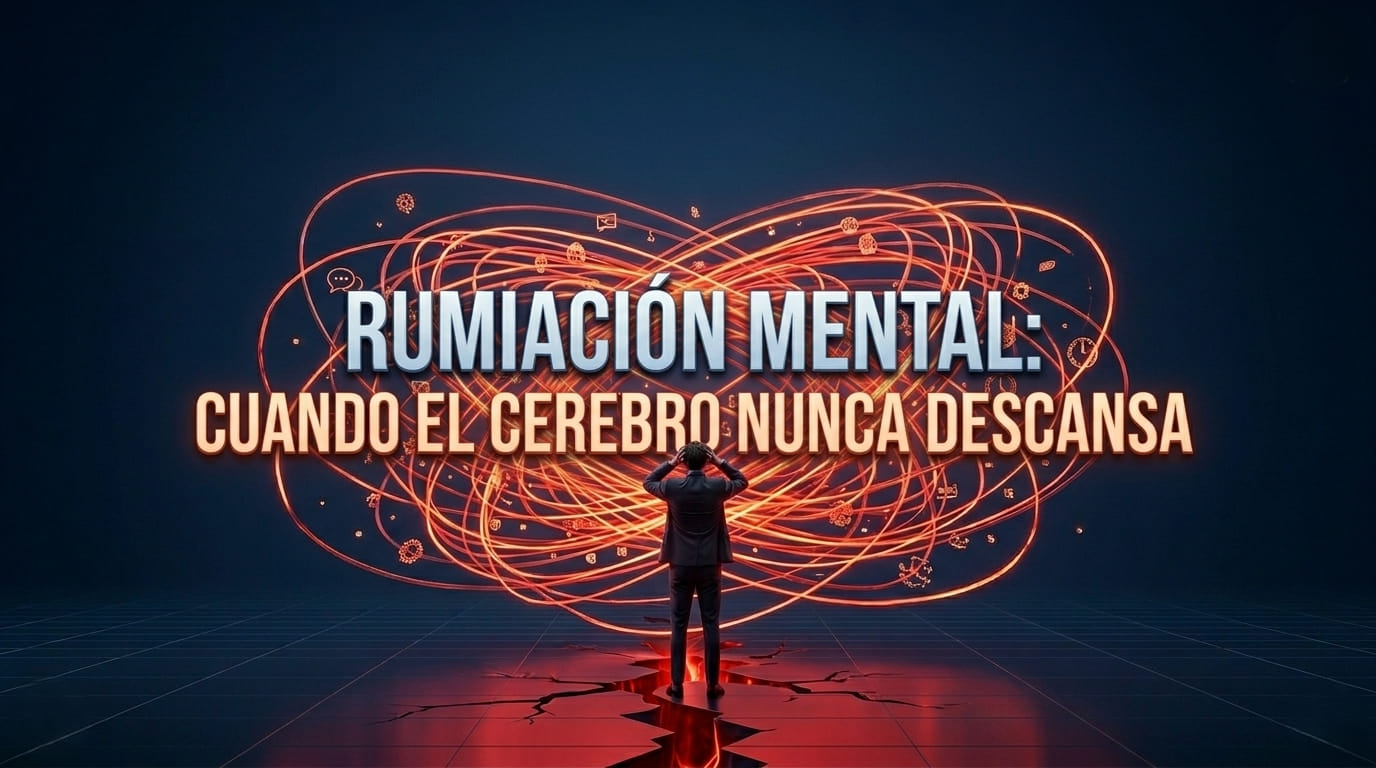
Rumination is exactly that: replaying conversations that already happened, rehearsing situations that haven’t occurred yet, analyzing the same scenario over and over without arriving at any concrete action. It’s like leaving a device in standby mode for hours on end — not actively doing anything, but draining the battery completely.
“The body recovers from adrenaline. It does not recover from the mental whirlpool.”
What actually happens in a ruminating brain
When the brain faces acute stress — a genuine threat — it is active but intact. It solves, it acts, it discharges.
When the brain is stuck in chronic rumination, something different happens: the prefrontal cortex (the region responsible for rational thinking and decision-making) becomes saturated. The brain appears, metaphorically, inflamed, fatigued, and foggy. Research on sustained psychological stress links this state to real neurological micro-inflammation affecting memory, concentration, and emotional regulation.
The result: you feel like you’re overthinking everything, you can’t “switch off,” and no amount of sleep seems to restore you.
The real-life case: the doctor who couldn’t rest
Picture this: a young physician, disciplined, sleeping her recommended 9 hours every night. But every morning she woke up exhausted.
The cause wasn’t her demanding work schedule. It was the fact that she spent her entire day mentally rehearsing conversations, rewriting responses she had already given, and anticipating scenarios that might never happen. Research suggests that up to 70% of idle mental activity in many people is consumed by these micro-worries — each one seemingly trivial, but collectively preventing the brain from ever entering genuine rest mode.
Her brain never turned off its emotional processing loop. There was no sleep deep enough to compensate for that.
Does this resonate?
This is not a personal failure
This is important: mental exhaustion is not a psychological failure.
You don’t collapse because you’re weak, because you feel too much, or because you lack enough willpower. Mental exhaustion from rumination is a neurological backlog — the brain simply never received the signal to stop processing. It’s not a character flaw. It’s a learned pattern that can change.
We don’t burn out from feeling deeply. We burn out from not allowing the brain to stop processing what we have already felt.
The solution: you need a physical interruption
This is where most people are surprised. The solution is not to “think less.” You cannot escape a thought loop by thinking about something else. The only real exit is physical.
When the mind enters a rumination cycle, the prefrontal cortex gets caught in a self-reinforcing loop. To break it, you need to change the physiological state of the body. This literally resets the neurological pattern.
Try these three interruptions the next time you notice the loop starting:
1. Cold water for 30 seconds
Hold your wrists under cold running water, or splash your face. The thermal shock activates the trigeminal nerve and the vagus nerve, sending an immediate signal to the nervous system: exit alert mode. It feels abrupt — because it works.
2. Climb stairs quickly
Vigorous movement metabolizes the excess cortisol and adrenaline that fuel the rumination cycle. The brain interprets “I am moving” as “the danger is over; action has been taken.” Two or three flights of stairs at a good pace can accomplish what an hour of “trying to relax” cannot.
3. Sing, squeeze your hands, or hum loudly
Activating the muscles of the jaw, throat, and hands releases accumulated tension in the somatic nervous system. Singing, in particular, stimulates the vagus nerve through chest vibrations — which is exactly the same mechanism behind the sound therapy and gong bath sessions we offer at Marce Anahata.
Why the body is the fastest exit from the mind
Every tradition that our practice draws from — yoga, somatic therapy, sacred ceremony, breathwork — points to exactly what neuroscience now confirms: the body is the fastest access point to regulate the mind.
You don’t need years of meditation to escape a rumination loop. You need to interrupt it physically, and with practice, build new regulatory habits that prevent the cycle from settling in the first place.
This is at the heart of our yoga and conscious movement classes: learning to inhabit the body as an intelligent self-regulation system. And in sound therapy sessions, the frequencies of Tibetan singing bowls and the gong do precisely what the neuroscience describes — they induce deep states of neurological coherence that mental effort alone rarely achieves.
When the exhaustion runs deeper
If you have been inside this cycle for months or years, rumination may have become a pattern that is difficult to shift alone. Sometimes we need an environment that regulates us while we learn to regulate ourselves.
That is exactly what our sacred rituals and wellness ceremonies are designed for: held spaces where the body can finally let go — where you are guided into rest rather than having to force yourself there.
And if you recognize this pattern in your team, our corporate wellness programs deliver concrete nervous system regulation tools that measurably improve performance without sacrificing mental health.
The one sentence to take with you
Your brain doesn’t need motivation. It needs interruption.
The next time you notice you have been thinking about the same thing for more than 15 minutes without any resulting action, don’t demand more willpower from yourself. Get up. Move your body. Change your physical state.
Your mind will follow.
Explore our wellness services and book a session →
Disclaimer: This content is educational and complementary in nature. If you are experiencing severe or persistent symptoms of burnout, anxiety, or depression, please seek support from a licensed mental health professional.